Radical Candor - A Leadership Skill of Giving Better Feedback
Radical Candor Masterclass with Amy Sandler


Jump to sectionWhen criticism means you careDeposits in the relationship bankThe Radical Candor matrix.Core: Praise and criticism Summary
Leadership
People
What is radical candor?
"Radical candor" is a communication framework for giving feedback developed by Kim Scott in her book "Radical Candor: Be a Kick-Ass Boss Without Losing Your Humanity."
The concept gives leaders a method for providing direct, honest feedback while also showing genuine care for their team members.
Radical candor involves finding a balance between being both challenging and caring in your communication, creating an environment where open and honest feedback can thrive.
Radical Candor lead coach Amy Sandler remembers being on the receiving end of radical candor. She shared her feedback story with Growth Faculty's Radical Candor masterclass:
"What did you think of that meeting?" her boss Steve had asked her after an important marketing presentation.
Up-and-coming manager Amy said she felt it had gone really well.
"What do you think Jenny and Brook (sic) thought of it? Steve asked. Did you notice you interrupted Jenny? You also jumped in and answered for Brook (sic)." he pointed out.
When criticism means you care
Amy admits getting this feedback from Steve was uncomfortable.
Steve continued.
"I know how much you care about your team and you're going to lose them. I believe you can be a great manager, and a great manager lets their team shine."
Amy told the class that Steve's feedback:
- Showed he cared and wanted to inspire her
- Was anchored in things that mattered to her
This is the essence of radical candor.
Deposits in the relationship bank
Amy says Steve was able to give her this feedback because he had made previously made "plenty of deposits in the relationship bank." She says he was a leader who prioritised real human relationships at work.
Free Download : 10 Leadership Qualities That Will Help Solve Challenges in 2024
Amy added that the reason radical candor is "radical" is because it is rare.
Amy asked us to think about how often we have problems that we don't bring up with the only person who can do something about it.
"You might be unintentionally be standing on my foot, but you are still standing on my foot!" she quipped.
The Radical Candor matrix.
So how do you learn radical candor? This Radical Candor matrix is a compass to help guide your conversations to a better place.
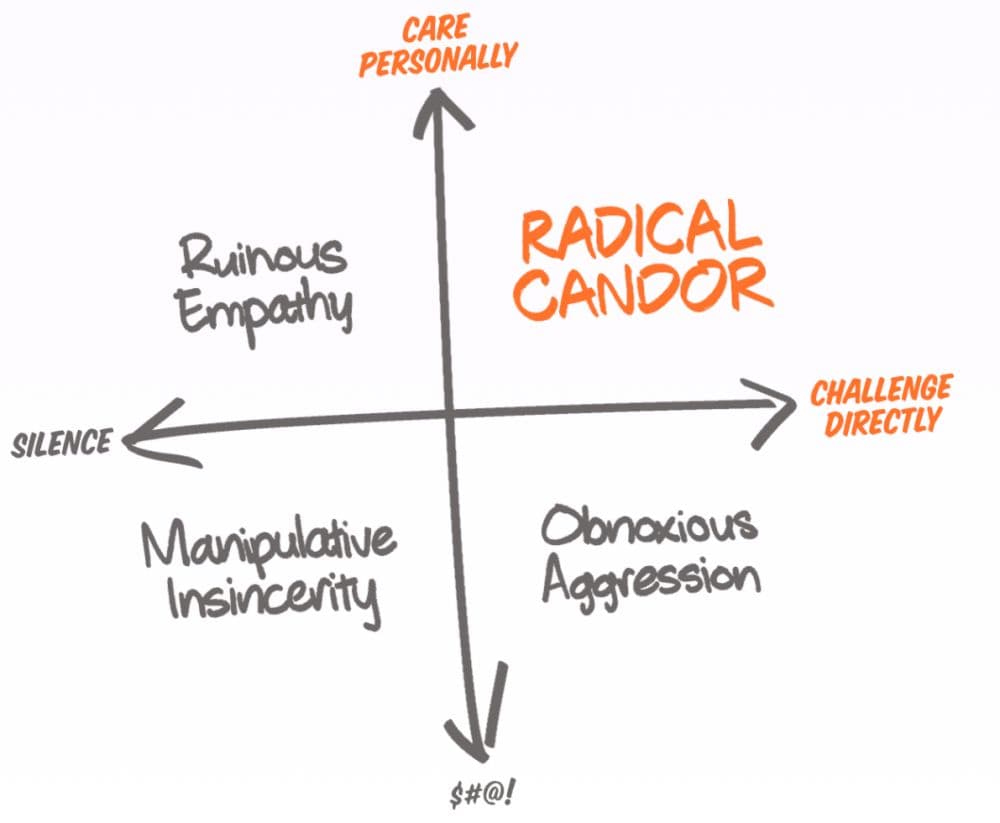
To practice radical candor you have to:
Care Personally: Give a damn!
- You're dealing with real human relationships so use common human decency (even love)
- Ignore the voice telling you to "Be professional!" and to leave the parts of being a human behind when you go to work. It leads to feeling apathetic about those we work with
- Suppress pseudospeciation, that strongly-wired part of our brain: "You're either with me, or you're against me"
Challenge directly: Be willing to piss people off!
Reject the motto taught to us as a child: If you don't have anything nice to say don't say anything at all. It's not just your job now, its actually your obligation!
Common but unhelpful conversations
Ruinous empathy (top left). = Conflict avoidance is why most of us end up in this quadrant. Empathy is foundational to relationships but becomes ruinous when were not challenging others in our relationships. It's the so-called sh*t sandwich without the sandwich.
Manipulative insincerity (bottom left) = This is the gossip, the sneaky 'meeting after the meeting'. It is very human but it leads to the most toxic of workplaces.
Obnoxious aggression (bottom right) This can blow up the relationship, it's "front stabbing" or acting like a jerk.
In our masterclass poll, when asked which mistake they most commonly made when not practising radical candor, 81% said they were guilty of ruinous empathy, 12% said they reverted to manipulative insincerity, and 10% admitted to obnoxious aggression.
Compassion is key
Another way to think about radical candor is compassionate candor.
In less forthright cultures it could be polite persistence.
- Compassion/polite is the care personally part of the radical candor.
- Candor/persistance is the challenge directly part.
Trust and vulnerability
Practicing radical candor helps to develop trust and safety; they mutually reinforce each other.
It's the sign of a fearless workplace. You know your manager cares about you if they take time to criticise you in private and praise you in public.
You feel safer to give feedback if your boss shows vulnerability: "I made a bunch of mistakes."
It gives permission for others to say, "Okay we're going to practice." Radical candor is a practice.
Hardest part of giving criticism
Three difficulties in _giving c_riticism:
- I don't want to hurt people's feelings
- I don't feel like I know the right thing to do or have the right words
- I'm concerned about retaliation
Hardest part of receiving criticism
The hardest part of receiving criticism was:
- If I feel like it's about me personally vs something I have done
- If it's vague or unclear
- If I don't trust the person giving it to me
Danger, danger, danger
In most people the question 'Can I offer you some feedback? generates a similar response to hearing fast footsteps behind you at night!' - Dr David Rock.
You hear "feedback" and your brain screams: Danger, Danger, Danger.
So move from "Can I give feedback?" to "I want to hear....." For example, "I want to hear what you thought of that meeting?"
How to get feedback, how to give it
Start with a growth mindset. Realise that you can only improve and grow from practicing and receiving radical candor.
Get it. Solicit feedback from your team especially if you're a boss. Show you want it. Show you can take it! Reward the candor.
Sample go-to questions for asking for feedback:
- What's something I did in the last week that made it difficult to work with me?
- In the last week, where did I get involved where you wish I hadn't (or avoid getting involved where you wish I had)?
- Here's what I tried to accomplish [on this project], how could I have approached it better?
Give it humbly, helpfully, immediately. Make praise and criticism like brushing and flossing your teeth. It becomes part of the conversation. Give more praise than criticism. Praise is like putting your foot on the accelerator, criticism is putting foot on the brake. Too much praise however wrecks motivation.
Gauge it measure it at the listener's ear. Was this landing as I intended?
Encourage it by doing this yourself, by bringing this to your team.
When it becomes emotional
We have all been in a meeting where we have cried, or the person we're with has cried.
The common response is to move to ruinous empathy - we drop any challenge after we ramp up the care.
Instead, acknowledge the emotion not "Oh, you look sad/angry" (for that just exacerbates or misrepresents the problem). And don't say "Don't take it personally."
Move up the CARE PERSONALLY axis but keep the CHALLENGE DIRECTLY:
- "What can I do right now that would be most helpful?"
- "What would work for you?"
Clean escalation
Nobody wants a toxic workplace, so try to eliminate side conversations.
Don't let people talk badly about each other to you.
Insist they talk with each other directly.
If they can't resolve it, ask them to come to you together.
Be as fast and fair as possible.
Core: Praise and criticism
When giving feedback, remember the C.O.R.E.:
Context: Give the context of the feedback. Cite the specific situation
Observation: Describe what was said and done (not about personal attributes)
Result: What is the consequence that is most meaningful (to you and them)
Expected next step: Discuss the best way to move forward
Summary
It takes courage to have difficult conversations.
But radical candor gets easier with practice. Amy Sandler told this week's Radical Candor masterclass the best way is to focus on Why this matters to me.
It might be the relationship is important, you care about this person, or it speaks to your inner values. I want to be the type of person who helps my team grow.
So, start practicing radical candor. Ask a partner to support and coach you.
And, most importantly, dare to start asking for feedback.
*Note: Radical Candor was written in the U.S. by Kim Scott. So, for consistency and readability, I have used the American spelling of the word candor throughout this blog. Kim Scott's other books are "Radical Respect: How to Work Together Better" and "Just Work: Get sh*t done, fast & fair."
Invest in your personal growth with Growth Faculty
Growth Faculty members benefit from a world-class immersive live virtual learning program of events - all included in their annual subscription. It’s an engaging and entertaining way to develop leaders.
Growth Faculty recently launched a good value Enterprise plan for larger companies to develop leadership skills across their whole organisation.
New events are being added regularly to this highly curated program. Keep an eye on the website Growthfaculty.com for fresh additions to the line-up.
There are separate multi-week live virtual programs for emerging leaders and for senior leaders; offering a condensed leadership course in a time-effective way.
For higher level leaders, including CEOs, there is an in-person Good to Great® Immersion Workshop with Jim Collins in Chicago, U.S., in October 2024. This is exclusively for executive teams and numbers are limited.
Images:
Amy Sandler, courtesy Amy Sandler
Radical Candor matrix from Radical Candor
Upcoming Learning
Who's Up Next?We're continually sourcing the world's greatest minds for your business success, so subscribe today for event updates, business ideas, leadership tips and tools for growth.
Related Articles