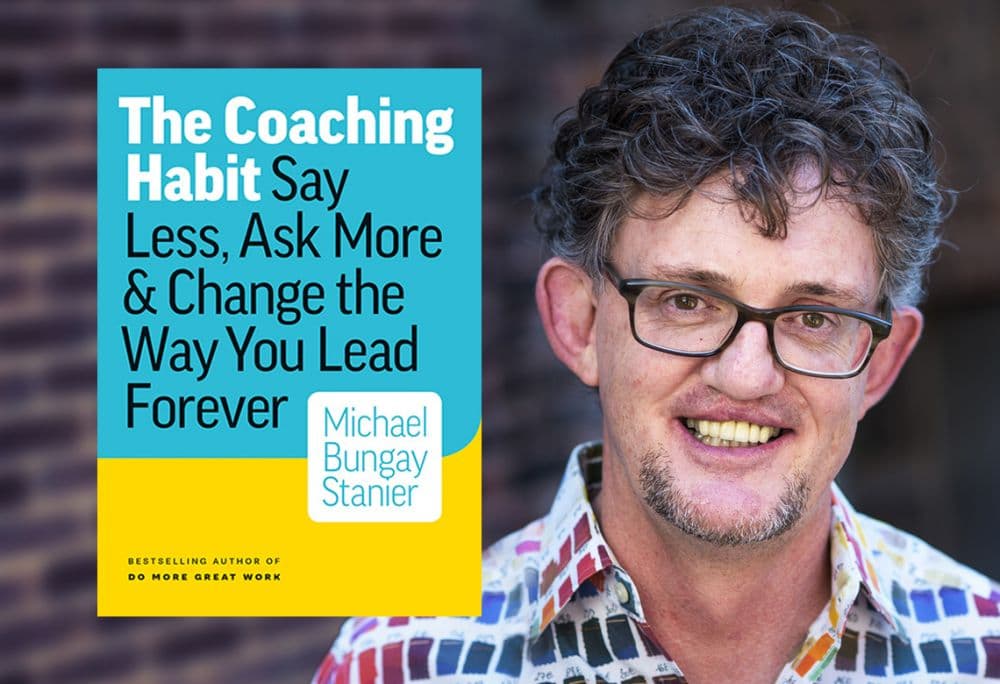
Great ideas from The Coaching Habit by Michael Bungay Stanier
Lessons from interview with bestselling author Michael Bungay Stanier
Jump to sectionSeven essential questions for leaders:Getting to know Michael Bungay Stanier Learning with Growth Faculty
Leadership
Strategy
People
"It takes courage to ask a question rather than offer up advice..... ["The Coaching Habit" is] a practical and inspiring book" - Brené Brown, author of "Dare to Lead."
Wall Street Journal bestseller, "The Coaching Habit" aims to make coaching an everyday way of working. As author of "Drive" Daniel Pink says in his testimonial: ["The Coaching Habit" will] help you provide more effective support to your employees and co-workers, and you may find that you become the ultimate coach to yourself."
Here, in brief, are key lessons from our interview with bestselling author of "The Coaching Habit" Michael Bungay Stanier:
Beware the Advice Monster. As soon as somebody starts talking, your Advice Monster goes: "This is brilliant, I'm going to add to this conversation by telling them stuff." But, by leaping in quickly, a couple of things happen. One, you might start solving the wrong problem. Two, you are training others that you are the answer to all their problems.
Try this: Go a minute without jumping in and giving advice. It's really difficult. Take a breath, notice the Advice Monster, then, before you tell them your advice, ask another question.
Here is the behaviour you are after : Can you stay curious a bit longer? Can you rush to action and advice giving a bit more slowly?
This helps: Don't think of yourself becoming a coach, but being more coach-like.
Seven essential questions for leaders:
- The kickstart question : What's on Your Mind? It's a good opening question that works.
- AWE question : And, what else? Keeps the Advice Monster at bay for a bit longer.
- The focus question: What's the real challenge here for you? The person solving the problem will learn, grow, and take responsibility for the problem.
- The foundation question: What do you want? Ask with a genuine sense of curiosity. It's a self-management tool too. When you are stressed or wound up, try asking yourself What do I want?
- The lazy question: How can I help? Instead of jumping in with advice, it forces the person presenting the problem to make a clearer request. It's a good question for replying to long emails. What do you want from me here? (Then press Send).
- The strategic question: If you're saying yes to this, what are you saying no to? This makes the opportunity cost real. You want to ensure everyone is doing more great work. Great work requires commitment.
- The learning question : What's been most useful for you? One of your most powerful roles is to be a teacher, and people learn when they reflect.
Getting to know Michael Bungay Stanier
We asked Michael Bungay Stanier to answer our "Great Eight" questions about his life and personal recommendations.
Recommended book? Bill Bryson, "The Short History of Nearly Everything," as well as Donald Horne, "An Imaginary Life." It's pretty magical.
If you could co-author a book with anyone, who would that be, and what would the book title be? Actually, I did talk to Brené Brown about co-authoring a book before she became famous. There's someone I am doing preliminary collaboration stuff with - Dr Jason Fox. Weve been doing some podcasting that hasn't been released yet. It would not be an ordinary title. It would be similar to The Heartbreaking Book of Staggering Genius.
What's a great bit of advice you could give? Hold no regrets for your past. Move on from the past. And, focus. I suffer from SOS, the shiny object syndrome. At (Michael's company) Box of Crayons, holding focus on offering practical coaching skills for everybody has been revolutionary for our company.
What's been your lowest moment, and how did you recover? I mostly have this incredibly robust sense of self. I've got stories of catastrophes and failures, but they were never low moments.
How do you relax? I read a lot, it depends on the book, but I'm a fast reader so I'm probably reading 50-100 books a year. Also, my wife has UAS Ukulele Acquisition Syndrome, so I also play ukulele with her.
What's a fun fact that's not widely known about you? I finished law school being sued for defamation by one of my lecturers during my law degree. I, and a group of others, complained about the way this lecturer was teaching a certain point of law using an example about a woman being raped. The lecturer eventually dropped the lawsuit.
What's the secret of success? Be different. I have a bias around this, because it worked for me; I was a Rhodes Scholar, and when I went for the entry interview, all the other applicants were in a blue suit and white shirt. I had long blonde hair and a purple suit. I was either going to come last by a long way, or they were going to bet on difference.
What's a prediction for 2025? Every five year plan I have ever made has been so utterly wrong, I'm not good at predicting the future. But, I will continue to be happily married.
Learning with Growth Faculty
When we approach professional development as a collaborative activity rather than a solo pursuit, we don't just build knowledge—we build stronger teams.
Our live learning sessions are designed with these principles at heart. They're not just about delivering information; they're about creating spaces where teams can discover together, challenge each other, and build the shared understanding that drives real innovation.
Download our 2025 program
Want to keep up with the latest ideas and thinking from the brightest minds in the world?
Download our blockbuster 2025 Program! Growth Faculty’s live virtual learning sessions feature some of the world's most influential thought leaders in business and leadership, many of them focusing on AI, change leadership, and adaptable leadership.
Events are added regularly, so keep up to date by signing up for our newsletter and see what’s on offer for Growth Faculty members.
Growth Faculty also offers a great value Enterprise plan for larger companies to develop leadership skills in teams of 20 or more employees.

Michael Bungay Stanier
Author of the Coaching Habit | Founder, Box of Crayons
Michael Bungay Stanier has shaped how organisations around the world make being coach-like an essential leadership competency. His book The Coaching Habit is the best-selling coaching book of this century, with over a million copies sold and more than fifteen thousand five-star reviews on Amazon.
In 2019, he was named the #1 thought leader in coaching, and in 2023, he won the coaching award from Thinkers 50, “the Oscars of management.” Michael was the first Canadian Coach of the Year, has been named a Global Coaching Guru since 2014, and was a Rhodes Scholar.
His most recent book, How to Work with (Almost) Anyone , shows how to create psychological safety by building the Best Possible Relationship with the key people at work. Michael is the host of the Change Signal podcast, which cuts through the blather, the BS, and the noise to find the good stuff that works in change management.
Michael founded Box of Crayons, a learning and development company that had helped hundreds of organizations transform from advice-driven to curiosity-led.
Michael is a compelling speaker and facilitator who combines practicality, humour, and an unprecedented degree of engagement with the audience. He’s spoken on stages and screens around the world in front of crowds of ten to ten thousand, and his TEDx talks have been watched by more than two million people.
Upcoming Learning
Who's Up Next?We're continually sourcing the world's greatest minds for your business success, so subscribe today for event updates, business ideas, leadership tips and tools for growth.
Related Articles