John Spence's strategic plan for success
Senior Leadership Program Session 4 Execution and Accountability
Strategy
Execution
Take two Harvard Business School professors, one former McKinsey consultant, 200 management techniques, 160 companies, and 10 years of data, and what do you have?
You have the answer to the question:
What management techniques really work to improve business performance?
As leading executive coach John Spence told Senior Leadership Program participants this week, the Evergreen Project resulted in the "4+2 formula" for business success.
The project found that, without exception, the companies that outperformed their industry peers excelled in 4 primary management practices : strategy, execution, culture, and structure.
Plus, any 2 of these 4 secondary management practices : talent, leadership, innovation, and mergers and partnerships.
This fits with John Spence's proprietary formula for business excellence:
- (Talent + Culture + Extreme Customer Focus) x Disciplined Execution = Business Excellence.
In this masterclass summary, we look at disciplined execution. See also our summaries of session 1 on talent (people), session 2 on culture, and session 3 on customer focus.
Businesses that struggle
John points out that the businesses that struggled most during the pandemic were missing key elements for success.
They lacked:
1. A vivid, compelling and well communicated vision and strategy for growth (people weren't aligned).
2. Courageous communication (there was a lack of psychological safety). Problems were there but no-one talked about them.
3.Disciplined execution and accountability.
What's the value of a strategic plan?
John says that no strategy equals no success.
"I've never worked with a successful company that did not have a clear strategy and focus to grow," he told participants.
He points to 6 reasons for having a strategic plan. They are:
- Direction, clarity, and alignment
- Resource optimisation
- Better decision-making
- Risk management
- Fosters collaboration and engagement
- Creates a competitive advantage
A strategic plan doesn't have to be complex
John points out that complexity kills a strategic plan. He also emphasises that strategy is just a guess, and is quick to debunk some myths around strategy.
"You don't have to be #1, it doesn't have to be new and exciting, and you don't have to be better at everything. Just get parity across almost everything."
He says that you DO have to figure out what to say no to, because strategy is the allocation of scarce resources, and you should only change your strategy when the market demands it.
Finally, he warns that competing on price is usually a race to the bottom and is usually not a good strategy.
Reasons strategies fail
Masterclass participants learned that the reasons strategies fail often comes down to:
1. Lack of alignment between strategy and organisational capabilities
2. Inadequate communication and understanding of the strategy (leaders should continually repeat the vision, mission, values, purpose, strategy for growth)
3. Resistance to change
4. Ineffective leadership and management
5. Lack of accountability and performance monitoring
Successful strategic plan examples
John pointed to the examples of Best Buy former CEO Hubert Joly and former Boeing and Ford CEO Alan Mulally as having simple but effective strategic plans.
Hubert Joly's plan focussed on four things, in this order: 1. People 2. Customers 3. Systems 4. Financials
John says that in his experience, companies that focused on financials first were more likely to lose customers and beat up their people.
Alan Mulally , who once told executive coach Marshall Goldsmith "Every day I remind myself that leadership is not about me. It is about the great people who are working with me" also had a strategy focused on people first.
His Working Together Principles (This is how I run every business) ran like this:
"People first, everyone is included, compelling vision, comprehensive strategy, relentless implementation, clear performance goals, one plan, facts and data, everyone knows the plan, the status and areas that need special attention, propose a solution, positive "find a way" attitude, respect, listen help and appreciate each other, emotional resilience, trust the process, have fun, enjoy the journey and each other, profitable growth for all."
A strategy for competitive advantage
John says competitive advantage comes down to this formula: Valued differentiation x disciplined execution.
He says there are 4 criteria to valued differentiation in your product or service:
- Unique and compelling
- Your target customer values it highly
- Its difficult if not impossible to copy
- You can consistently execute it with excellence).
What does your company do that clearly meets all 4 of these criteria?
Emotional responses to change
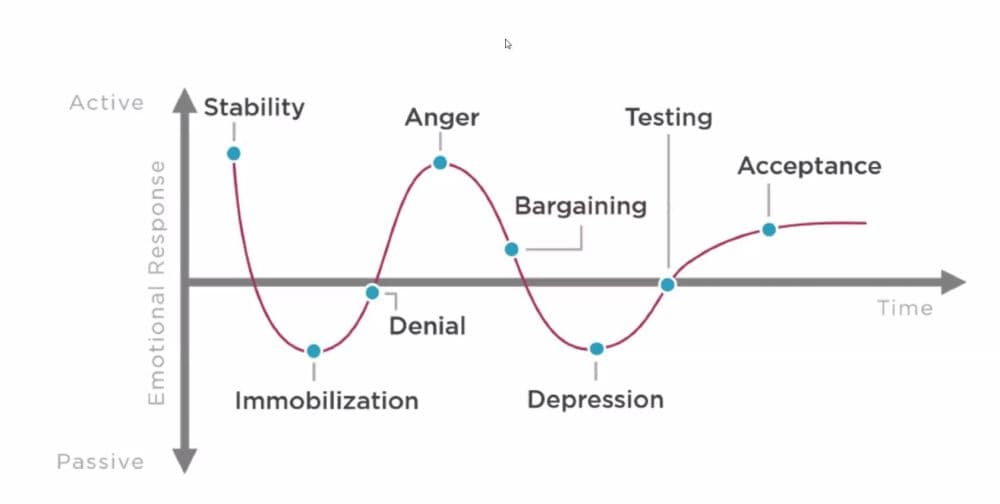
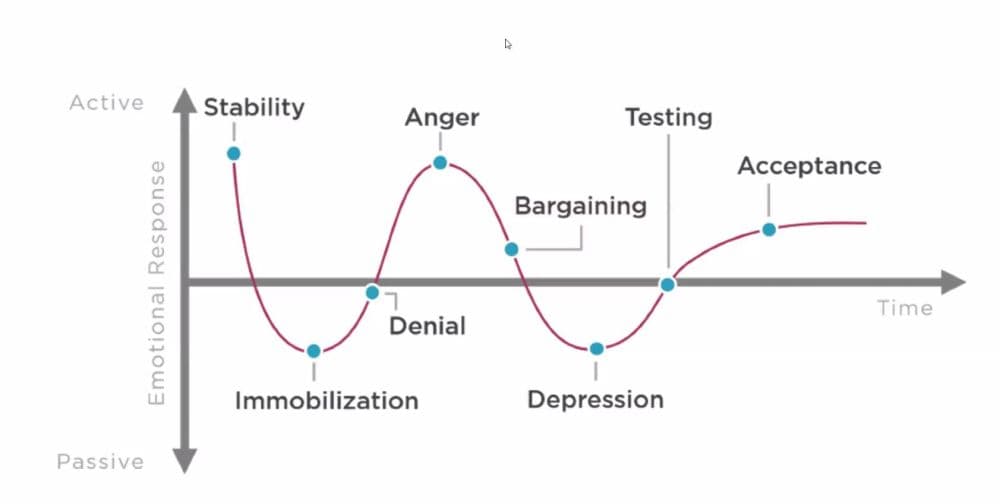
Change can be perceived as scary to the team. Team members are likely to go through varying emotional responses on their way to accepting the change.
You don't just throw a strategy change at people, says John. You need to plan and communicate the change.
Based on John Kotter's 8 step program to manage the change process, John Spence suggests leaders focus on:
- Making an irresistible case for change (i.e. show how resistance is futile)
- Painting a vision of the future
- creating a sense of urgency (to move there quickly)
- Assembling a guiding coalition (trusted and respected team members who are champions of getting on board the change)
- Ensuring continuous communication
Checklist: 6 keys to accountability
When creating a culture of accountability, clarity in communication and collaboration are vital. John has this checklist for keeping people accountable:
- 100% clarity + appropriate authority and resources (in excruciating detail explain what success looks like, due dates, KPIs, hurdles that have to be met, then make sure they have the authority and resources to achieve success).
- 100% agreement. (John gets that person to write a memo back with their understanding of what he's told them, with details. This is called an accountability agreement).
- Track and post. Track the progress and post it so they can see it, so it's highly visible. (Green, yellow, red flags to indicate if on track).
- Coach, mentor, train , and support.
- Celebrate success.
Refuse to tolerate mediocrity
When faced with a direct report who consistently fails to do satisfactory work, try John Spence's 4 pieces of paper method. Instead of telling the employee what to do, ask them to fill out four pieces of paper.
- What you will do in the 30, 60, 90 days to show me that you should stay on the team? John says he likes it to be binary, no ambiguity
- What do you need from me as your manager to make that happen?
- What is a small reward you'd like if you deliver everything you deliver everything on paper number 1?
- What should the ramifications be if I give you everything you ask for and you don't deliver?
That brings us to the end of our final masterclass in our Senior Leadership Program series of masterclasses, led by executive coach John Spence. Keep up to date by downloading Growth Faculty's latest program of live virtual and in-person events.
Growth Faculty membership
They say that when organisations are moving fast, there's rarely enough time and space for informal training and support, particularly for managers.
Our immersive live virtual learning program with Growth Faculty membership is one option to consider when researching how best to develop aspiring Level 4 leaders.
Growth Faculty recently launched a good value Enterprise plan for larger companies to develop leadership skills in teams of 20 or more employees.
John Spence
John Spence is recognised as one of the top leadership development experts in the world. In 2023 he was named in the Top 50 Global Thought Leaders and Influencers for both Coaching and Culture (Thinkers360) and was once named one of America’s Top 50 Leaders to Watch by the American Management Association alongside Sergey Brin and Larry Page of Google and Jeff Bezos of Amazon.
John consults to and coaches organisations at all levels on advanced leadership, high-performance teams, strategic thinking, business excellence and superior customer service. John has guest lectured at more than 90 colleges and universities, including MIT, Stanford, Cornell, and the Wharton School of Business.
John has also been the owner or CEO of five companies and currently serves as a board member or adviser to several organisations. He is the author of “Awesomely Simple: Essential Business Strategies for Turning Ideas into Action.”
Let’s talk about:
- Foundations of business excellence
- Strategy that works
- Characteristics of outstanding leadership
Upcoming Learning
Who's Up Next?We're continually sourcing the world's greatest minds for your business success, so subscribe today for event updates, business ideas, leadership tips and tools for growth.
Related Articles